Pileus Technologies: Blog
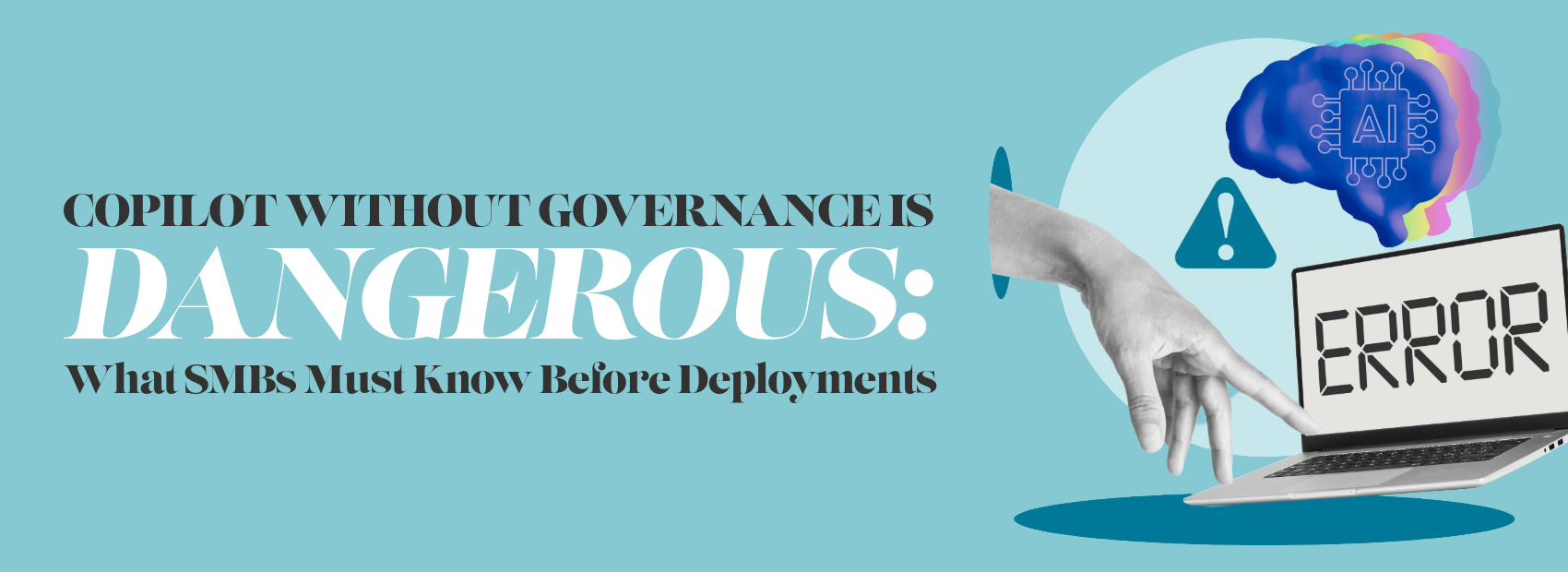
Copilot Without Governance Is Dangerous: What SMBs Must Know Before Deployment
Copilot Governance Risks are becoming a serious concern for small and medium-sized businesses deploying Microsoft Copilot inside Microsoft 365 environments. While many organizations are excited about AI-powered productivity, few realize how sensitive business information Copilot can access once connected to corporate systems.
Microsoft Copilot can dramatically improve productivity by helping employees:
- Summarize meetings
- Draft emails
- Build presentations
- Analyze spreadsheets
- Generate reports
- Search organizational knowledge
However, Copilot also introduces new security, compliance, and operational concerns when businesses deploy it without governance standards.
Unfortunately, many SMBs assume Copilot is automatically secure simply because it operates within Microsoft 365. Copilot often exposes existing data management problems that organizations already have.
As a result, businesses may unintentionally expose:
- Confidential documents
- HR records
- Financial information
- Legal agreements
- Client communications
- Sensitive SharePoint files
to employees who should not have visibility into that information.
According to Microsoft Responsible AI guidance, organizations should establish governance, security controls, and data access policies before deploying AI systems broadly across the workplace.
What Is Copilot Governance?
Copilot governance refers to the policies, permissions, security controls, compliance standards, and operational processes that manage how Microsoft Copilot accesses and interacts with organizational data.
Microsoft Copilot works by accessing the data that employees already have permission to view across:
- SharePoint
- OneDrive
- Teams
- Outlook
- Word
- Excel
- PowerPoint
- Microsoft Graph
This means Copilot does not magically create security issues. Instead, it often reveals the security and permission problems that already exist inside the organization.
For example, many SMBs have years of:
- Poor SharePoint permissions
- Overexposed Teams folders
- Shared executive files
- Public OneDrive links
- Unstructured data storage
- Inconsistent document governance
Without proper governance, Copilot may surface that information instantly through natural language prompts.
As a result, employees may gain visibility into sensitive business information they were never expected to discover easily.
Copilot Can Expose Overshared Data
One of the largest Copilot Governance Risks involves oversharing.
Historically, many organizations granted employees broad access to files because it made collaboration easier. Unfortunately, AI changes the risk equation dramatically.
Previously, employees had to manually search through folders to locate information. Now, Copilot can summarize and retrieve information in seconds.
For example, an employee could ask:
- “Show me salary planning documents.”
- “Summarize leadership discussions about layoffs.”
- “Find cybersecurity incident reports.”
- “Show me contract disputes from last quarter.”
If permissions are not configured properly, Copilot may surface sensitive information unexpectedly.
Consequently, SMBs must audit permissions and data access before enabling Copilot organization-wide.
Microsoft recommends organizations review SharePoint permissions, sensitivity labels, and governance policies before deployment. Businesses can learn more through Microsoft Purview data governance and compliance solutions.
Shadow Data Becomes a Major Problem
Many SMBs already struggle with shadow technology and unstructured data storage. Copilot amplifies those concerns.
Shadow data refers to:
- Forgotten files
- Duplicate documents
- Old spreadsheets
- Archived communications
- Legacy folders
- Unmanaged Teams channels
- Employee-created repositories
Unfortunately, organizations often lose visibility into where sensitive data resides.
As a result, Copilot may retrieve outdated, inaccurate, or sensitive information from locations leadership forgot existed.
This creates several business concerns:
- Compliance exposure
- Data leakage
- Inaccurate reporting
- Employee confusion
- Regulatory risks
Consequently, SMBs should perform data cleanup initiatives before deploying AI broadly.
Compliance Risks Increase Without Governance
Many SMBs operate under regulatory frameworks involving:
- HIPAA
- PCI-DSS
- SOC 2
- CMMC
- FTC Safeguards Rule
- Financial privacy requirements
Unfortunately, Copilot can unintentionally expose regulated information if governance standards are weak.
For example, employees may accidentally access:
- Protected health information
- Financial accounting records
- Client agreements
- Personally identifiable information
- Legal communications
through natural language AI searches.
As a result, organizations may create compliance violations without realizing it.
The NIST AI Risk Management Framework recommends businesses implement AI governance and risk management frameworks to reduce operational and cybersecurity exposure tied to artificial intelligence systems.
Poor Data Hygiene Makes Copilot Dangerous
Many organizations want AI productivity benefits without addressing years of poor data management.
Unfortunately, Copilot magnifies existing operational problems involving:
- File sprawl
- Permission inconsistencies
- Unmanaged collaboration
- Weak governance
- Outdated retention policies
- Inaccurate records
Consequently, organizations with poor data hygiene face significantly higher Copilot Governance Risks.
For example:
- Old HR documents may still be searchable
- Sensitive spreadsheets may be widely accessible
- Former employee files may remain active
- Executive discussions may exist in unsecured Teams channels
Therefore, Copilot readiness is primarily a data governance discussion.
AI Hallucinations Still Create Business Risk
Although Microsoft Copilot operates inside Microsoft 365 environments, it still relies on generative AI systems.
As a result, hallucinations remain possible.
AI hallucinations occur when AI systems generate:
- Incorrect summaries
- False assumptions
- Inaccurate calculations
- Misleading recommendations
- Fabricated details
Unfortunately, employees may trust AI-generated output too quickly.
Consequently, inaccurate information can spread into:
- Executive reporting
- Financial forecasting
- Customer communication
- Compliance documentation
- Internal planning
Therefore, organizations should train employees to validate AI-generated information before relying on it in operational settings.
The Cybersecurity and Infrastructure Security Agency (CISA) also recommends organizations establish AI governance controls and operational visibility before large-scale AI adoption.
SMB Departments Most Affected by Copilot Governance Risks
Copilot Governance Risks affect nearly every department inside an organization.
Sales Teams
Sales professionals may unintentionally expose:
- Client proposals
- Pricing models
- Contract discussions
- Customer communication
through poor permission structures.
Human Resources
HR departments often store:
- Salary information
- Employee reviews
- Benefits data
- Disciplinary records
Without proper controls, Copilot may expose highly confidential HR content.
Finance Teams
Finance departments manage:
- Forecasts
- Payroll records
- Banking information
- Budget planning
As a result, governance failures could expose sensitive financial information.
Executive Leadership
Executives often maintain:
- Acquisition discussions
- Strategic planning
- Legal communications
- Organizational restructuring plans
Copilot visibility into these areas creates substantial operational risk.
IT and Security Teams
Technical departments frequently manage:
- Incident reports
- Security vulnerabilities
- Administrative credentials
- Infrastructure documentation
Therefore, IT governance becomes critical before AI deployment.
How SMBs Can Reduce Copilot Governance Risks
Organizations should approach Copilot strategically rather than enabling it broadly without preparation.
Conduct a Permission Audit
Businesses should review:
- SharePoint permissions
- Teams access
- OneDrive sharing
- File inheritance settings
- Legacy repositories
Implement Data Classification
Sensitivity labels help organizations control:
- Confidential information
- Financial records
- Legal documentation
- Client data
Create AI Governance Policies
Employees need clear guidance involving:
- Acceptable AI usage
- Restricted information
- Compliance expectations
- Approval workflows
- Security responsibilities
Train Employees Properly
AI literacy training should include:
- Prompt security
- AI hallucination awareness
- Data privacy standards
- Responsible AI usage
Clean Up Legacy Data
Organizations should archive or remove:
- Outdated files
- Duplicate records
- Unused Teams channels
- Former employee data
- Inactive repositories
As a result, Copilot operates in a cleaner, more secure environment.
Copilot Readiness Is Really a Governance Discussion
Many SMBs think Copilot deployment is primarily a technology project. In reality, successful AI adoption depends heavily on governance maturity.
Organizations that rush deployment without preparation may face:
- Security incidents
- Compliance exposure
- Data leakage
- Employee distrust
- Operational confusion
Meanwhile, businesses that prioritize governance first will gain:
- Better AI outcomes
- Stronger security
- Cleaner collaboration
- Improved compliance
- Greater operational efficiency
Consequently, Copilot readiness should involve leadership, IT, compliance, HR, and operations together.
Final Thoughts on Copilot Governance Risks
Copilot Governance Risks are quickly becoming one of the most important topics of conversation surrounding AI adoption in SMB environments. While Microsoft Copilot offers tremendous productivity opportunities, businesses must recognize that AI also magnifies existing governance weaknesses.
Organizations should not fear AI. However, they should deploy AI responsibly.
The businesses that succeed with Copilot will:
- Govern data properly
- Train employees effectively
- Establish security controls
- Improve visibility
- Create structured AI policies
Most importantly, SMBs must understand that Copilot is not simply a productivity tool. It is a visibility accelerator into organizational data.
Want to prepare your business for secure Copilot deployment?
Start with:
- A Microsoft 365 permission audit
- SharePoint governance review
- AI governance workshops
- Data classification assessments
- Copilot readiness evaluations
The organizations that govern AI properly today will avoid major security and compliance problems tomorrow.